
Introduction
Let me be straight with you.
Most small business owners I talk to are not losing customers because their product or service is bad. They are losing customers because nobody can find them online. That is a fixable problem.
Local SEO is how you fix it. And no, you do not need a big budget or a tech background to get started. You just need to understand what matters and take action on it consistently.
This guide covers everything you need to know, in plain language, with steps you can actually use.
What Local Search Ranking Means and Why You Should Care
Every time someone picks up their phone and types the best dentist near me or auto repair shop in Brooklyn, Google goes to work. It scans its database and decides which businesses to show first.
The businesses that show up at the top of that list get the calls. They get the walk-ins. They get the sales. The ones buried on page two? They might as well not exist.
Your local search ranking is simply where your business appears in those results. The higher you are, the more visible you are. The more visible you are, the more customers you get. That is the whole game.
Why Small Businesses Cannot Afford to Ignore This
Here is something worth thinking about. When someone searches for a service near them, they are not browsing. They are ready to make a decision.
That is different from someone scrolling through social media who might buy something someday. A local searcher wants help today. They want a phone number to call, an address to visit, or a website to check out right now.
Local SEO connects you to those people at exactly the right moment.
Here is what it can do for a small business:
- Bring in customers who are already looking for what you sell
- Build credibility through reviews and a polished online profile
- Help you compete with bigger brands that have larger ad budgets
- Create lasting visibility that does not disappear the moment you stop paying
A good digital marketing services agency will tell you that local SEO is one of the highest return investments a small business can make. Not because it is trendy, but because it works.
How Google Decides Who Ranks Where
Before you start optimizing anything, it helps to understand what Google is actually looking at. Google uses three main signals for local rankings.
- Relevance: is about whether your business matches what the person searched for. If your Google profile clearly describes what you do, Google can match you to the right searches.
- Distance: is exactly what it sounds like. How close is your business to the person searching? You cannot change your location, but you can make sure Google knows it.
- Prominence: is about how well known and trusted your business is. This includes your reviews, the websites that link to you, how complete your profile is, and how active you are online.
When you understand these three things, everything else in local SEO starts to make sense.
Start With Your Google Business Profile
If there is one thing you do after reading this, make it this.
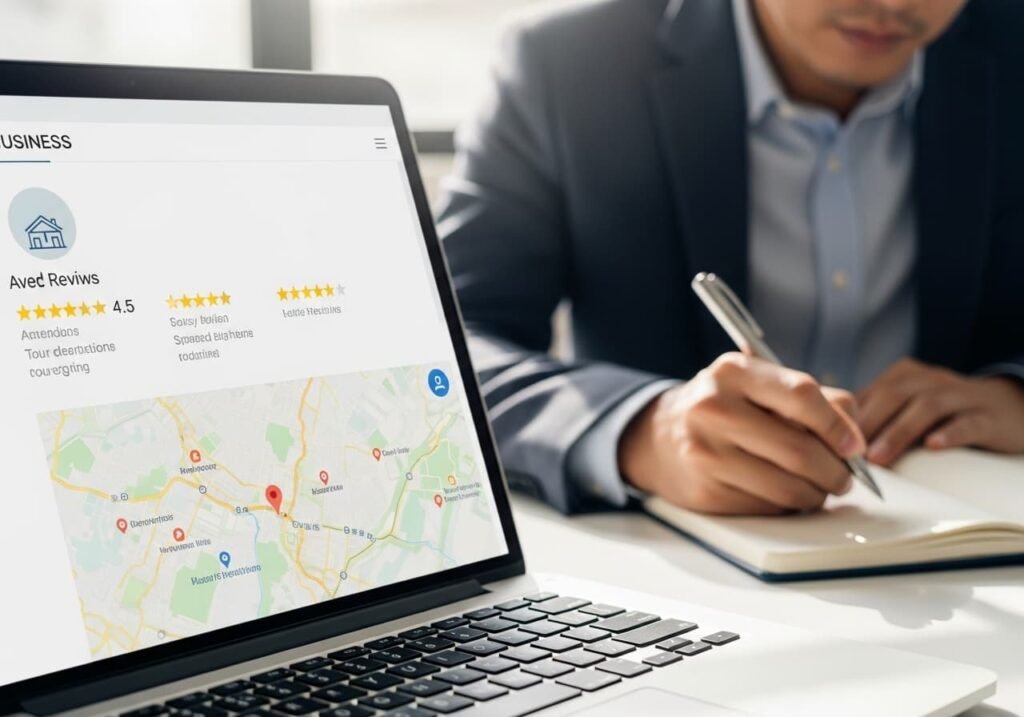
Your Google Business Profile is the single most important asset you have for local search. It is what shows up in the Map Pack, the section at the top of local search results with the map and three business listings. Getting into that section is the goal.
Here is what a complete, optimized profile looks like:
- Your exact business name, address, and phone number filled in correctly
- The right business category selected (be specific, not vague)
- Your actual hours, including holiday hours when they change
- A clear, honest business description written in plain language
- At least ten photos showing your location, your work, and your team
- Regular posts, the same way you would update a social media page
A lot of business owners claim their profile and then forget about it. That is a mistake. Google rewards active profiles. If you post updates, respond to reviews, and keep your information current, you signal to Google that your business is alive and worth showing to people.
Getting Local Keywords Right
Keywords are just the words and phrases people type when they search. For local SEO, you want to be thinking about location based phrases, not just general ones.
Flooring company is a general keyword. Flooring company in Queens is a local keyword. The second one is what brings you customers who can actually visit your store or call your number.
Here is how to approach it without overcomplicating things:
- Think about the exact words your customers use when they describe your service. Not industry terms. Their words.
- Type your service into Google and look at the suggestions that come up. Those are real searches real people are making.
- Use your city, neighborhood, and nearby landmarks naturally throughout your website content.
- Do not stuff keywords into every sentence. It reads badly and Google has seen that trick a thousand times.
One thing that a lot of businesses miss is search intent. Someone searching for an emergency locksmith near me needs help at this minute. Someone searching how locksmiths open doors is just curious. Your content should speak to both, but make sure your main pages are built for the buyer, not the browser.
Working with someone who offers digital marketing services near you can help you nail down the right keyword strategy for your specific market, especially if you are in a competitive area.
Your Website Needs Basic On-Page SEO
You do not need a hundred page website. But the pages you do have need to be set up correctly.
On-page SEO is about making sure the content on your website tells Google and your visitors exactly who you are, what you do, and where you are located.
A few things to check right now:
- Does your homepage title include your city and your main service?
- Does each page have one clear H1 heading that describes what that page is about?
- Is your business name, address, and phone number somewhere on every page, ideally the footer?
- Are your page descriptions (meta descriptions) clear and written for a human, not just a search engine?
- Does your site load in under three seconds?
That last one trips up a lot of small businesses. A slow website loses visitors before they even read a word. Use Google’s free PageSpeed Insights tool to check yours and see what needs fixing.
Building Local Backlinks Takes Time but Pays Off
A backlink is simply a link from another website to yours. Google treats these like recommendations. If trusted local websites are linking to you, it sees your business as more credible.
You do not need dozens of them. A handful of good ones from relevant local sources makes a real difference.
Here are some realistic ways to get them:
- List your business on Yelp, the Better Business Bureau, and your local Chamber of Commerce directory
- Reach out to local bloggers or news sites about a story related to your business
- Partner with another local business on a joint promotion and link to each other
- Sponsor a community event, school fundraiser, or charity that has a website
- Submit to any industry specific directories that cover your type of business
The key word in all of this is local. A link from a local news site or neighborhood blog is worth far more for local SEO than a random link from a website that has nothing to do with your area.
Reviews Are Not Optional
I know asking for reviews feels awkward. Most business owners feel that way at first.
But here is the reality. Reviews are one of the biggest factors in local search rankings. They are also the thing that convinces a potential customer to call you instead of the competitor two spots above you.
People read reviews. They trust them almost as much as a personal recommendation from a friend.
Here is a simple system that works:
When you finish a job or a customer leaves happy, send them a quick text or email with a direct link to your Google review page. Make it one tap to get there. Most people are willing to leave a review when the process is easy and the timing is right.
Then respond to every single review. Thank the ones who left kind words. Address the negative ones calmly and professionally. Even if a complaint seems unfair, how you respond tells future customers more about your business than the complaint itself.
Never buy fake reviews. It is against Google’s rules and it backfires badly when the algorithm catches it.
NAP Consistency Is a Small Detail With a Big Impact
NAP stands for Name, Address, and Phone Number. Sounds simple. But this is where a surprising number of businesses quietly hurt their own rankings.
Google checks your business information across dozens of websites and directories. If it finds different versions of your address or phone number in different places, it gets confused. And a confused algorithm tends to rank you lower.
The fix is straightforward:
Pick one exact way to write your business name, address, and phone number. Then go through every directory, every social media profile, every listing you can find and make them all match perfectly.
Watch for things like Street vs St or a suite number that shows up in some places and not others. Those small differences add up.
If you moved locations or changed your phone number at some point, old listings with the previous information are actively hurting you. Track them down and update them.
If Your Website Is Not Mobile Friendly, You Are Losing People
More than half of all local searches happen on a phone. If your website is hard to use on a small screen, people leave. They go to your competitor.
It is that simple.
Google also looks at your mobile site first when deciding how to rank you. This is called mobile first indexing. So even from a pure SEO standpoint, a bad mobile experience is a problem.
Run your site through Google’s Mobile Friendly Test. It is free and takes about thirty seconds. If issues come up, fix them or have someone fix them.
The basics matter here:
- Text should be readable without zooming
- Buttons should be easy to tap
- Pages should load fast even on a slower connection
- Your phone number should be a clickable link
That last point is one most people overlook. If someone finds you on their phone and wants to call, they should not have to copy and paste your number. One tap should do it.
Content Marketing Works for Small Businesses Too
You do not have to publish blog posts every week. But having some useful, location specific content on your website can genuinely help your search visibility over time.
Think about the questions your customers ask you all the time. Those are blog post topics.
How do I know when my roof needs replacing in a rainy climate like Seattle?
What should I ask a catering company before booking them for a corporate event in Manhattan?
How long does a typical kitchen renovation take in an older Brooklyn brownstone?
These kinds of posts attract people who are in the early stages of making a decision. They are doing research. If your content answers their question, you build trust before they ever contact you.
This is one of the smarter long term plays in local SEO. Result Driven Digital Marketing is not just about showing up in search. It is about showing up as the most helpful and credible option.
How Long Will This Actually Take?
Most people want an honest answer here and not a vague non answer.
Here is the truth. Some things move quickly. Cleaning up your Google Business Profile and getting a handful of new reviews can show impact within four to six weeks.
Other things, like building backlinks and growing your domain authority through content, take three to six months before you notice real movement.
The businesses that win at local SEO are not the ones who do everything perfectly in month one. They are the ones who keep going. They update their profile. They keep asking for reviews. They fix the slow pages. They add a new blog post every couple of months.
That consistency compounds. After a year of doing the basics well, you will be in a significantly stronger position than a competitor who did a burst of activity and then stopped.
Mistakes That Hold Small Businesses Back
After working through local SEO with all kinds of small businesses, the same patterns show up again and again.
These are the most common ones:
- Claiming the Google Business Profile and never touching it again: An inactive profile sends the wrong signals. Log in regularly. Add photos. Post updates.
- Targeting too many cities at once: If you are just getting started, pick your most important market and dominate it before spreading out.
- Ignoring negative reviews: A bad review that goes unanswered looks worse than the review itself. Always respond.
- Having a website that looks fine on a desktop but breaks on mobile: Check it on your own phone right now.
- Inconsistent business information across the web: This one quietly kills rankings for years before people figure out what is happening.
- Writing content for search engines instead of people: Cramming keywords into sentences makes them unreadable. Write for your customer first. The SEO follows.
How Mazibex Digital Approaches This for Small Businesses
Mazibex Digital works specifically with small businesses on building real, lasting local search presence. They do not use templates or run the same playbook for every client.
Their process starts with a full audit of where the business stands online. What is working, what is broken, and what gaps exist compared to local competitors. From there they build a practical plan focused on the things that will actually move the needle.
Mazibex Digital recently started offering digital marketing services in New York, with a specific focus on neighborhoods like Brooklyn, where local competition tends to be intense and the margin between ranking and not ranking is often just a few key improvements.
For business owners looking for a digital marketing services agency that explains things in plain language and focuses on real results, Mazibex Digital is worth a conversation. They operate on the idea that Marketing that Scales Your Business has to be grounded in strategy, not just activity.
Start Here: Actions You Can Take This Week
You do not have to tackle everything at once. Pick the ones you have not done yet and start there.
- Log into Google and claim or update your Google Business Profile
- Make sure your business name, address, and phone number are identical everywhere online
- Send a review request to three customers you helped recently
- Pull up your website on your phone and see how it actually looks and performs
- Add your city or neighborhood naturally to the top of your homepage if it is not already there
That is it for week one. Small steps done consistently beat grand plans that never get started.
Frequently Asked Questions
What is the single most important thing I can do for local SEO right now?
Complete your Google Business Profile fully and get it active. If you have not done that yet, nothing else matters as much. It is the foundation everything else builds on.
Can I do local SEO myself or do I need to hire someone?
You can absolutely handle the basics yourself. Many small business owners do. As your market gets more competitive or your time gets tighter, bringing in a professional makes sense. A good digital marketing services agency pays for itself when they free up your time and find gaps you would not have spotted.
How many reviews do I actually need?
Focus on getting a consistent flow of them rather than hitting a specific number. Ten recent reviews beat fifty old ones. Google cares about freshness. Keep asking.
Does posting on social media help my Google ranking?
Not directly. Social media does not change your search ranking. But it drives awareness and traffic to your website, and that activity has indirect benefits over time.
My competitor has been in business for less time than me. Why do they rank higher?
Business age is not a ranking factor. They almost certainly have more reviews, a more complete profile, or more local backlinks than you. Close those gaps and you close the ranking gap.
Where to Go From Here
Local SEO is not complicated once you strip away the noise. It comes down to being easy to find, easy to trust, and easy to contact.
A complete Google profile. Consistent business information everywhere online. A steady flow of genuine reviews. A website that works on a phone. Some useful content that answers real questions.
Do those things and keep doing them. That is the whole strategy.
If you want support along the way, look for digital marketing services near me that focus on small business growth rather than big agency overhead. The right team will not overwhelm you with jargon. They will show you what to prioritize and help you execute it.
Your customers are searching. Make sure when they do, they find you. Read more